How to choose tile for a bathroom, kitchen, floor, or terrace
A practical framework for choosing tile by moisture, traffic, slip resistance, format, maintenance, and installation conditions.
The right tile starts with a simple question: what will happen to this surface every day? A bathroom wall gets wet, a hallway receives grit, a kitchen sees grease and stains, and a terrace experiences temperature changes.
That is why two tiles with the same dimensions can have different intended uses. Compare the technical sheet, surface, format, installation method, and future availability—not just the colour.
1. Write a short technical brief
Record five things: wall or floor; dry, wet, or exterior environment; light, residential, or heavy traffic; format and pattern; cleaning routine. This immediately removes many unsuitable collections.
Also note underfloor heating, waterproofing, a timber or other moving substrate, existing tile, and complicated junctions. Tile cannot fix a weak substrate, and adhesive and movement joints must suit the complete assembly.
2. Bathroom: water, grout, and safety
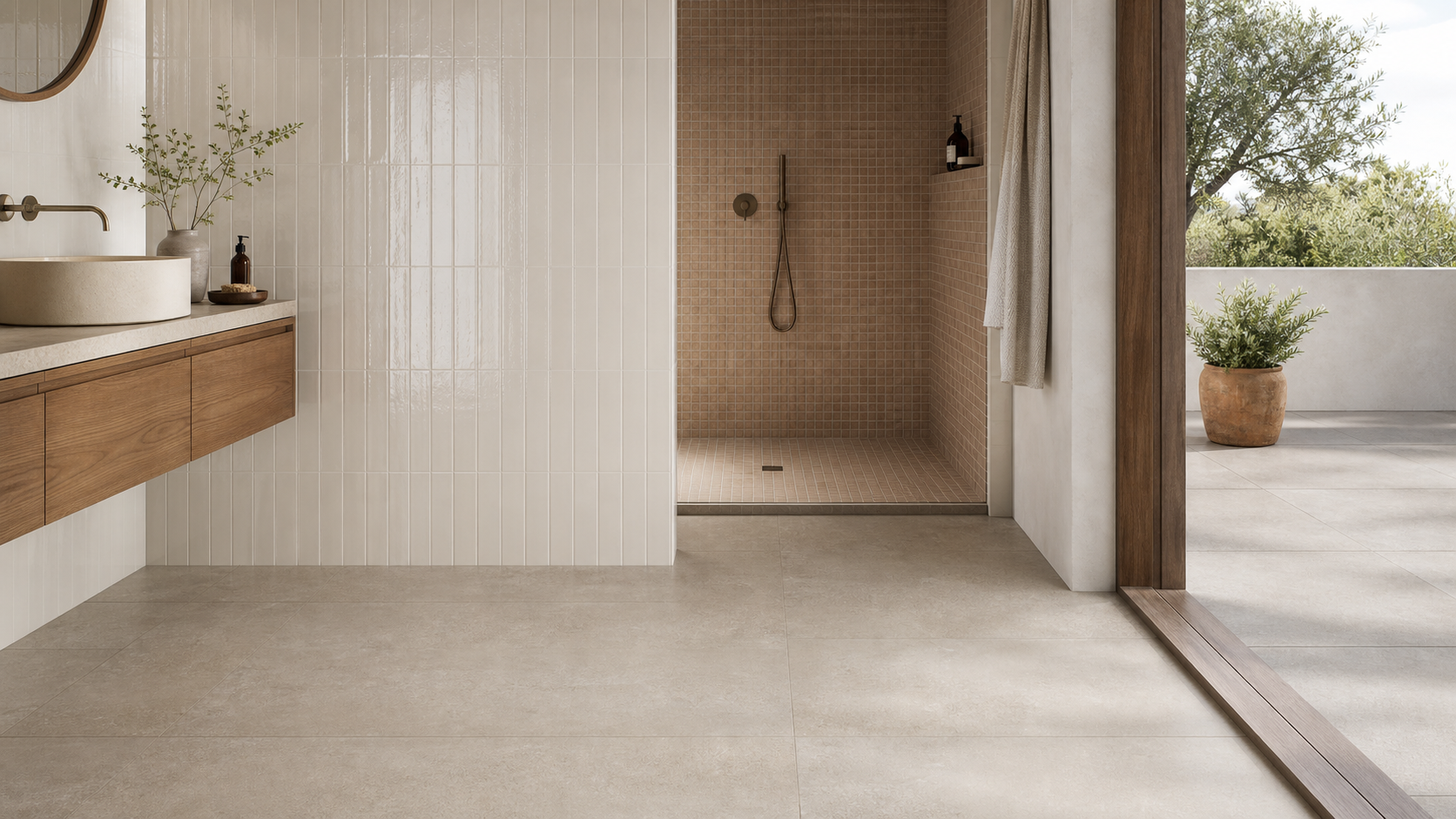
On bathroom walls, prioritise cleanability, colour stability, and compatibility with the adhesive and grout. On the floor, add slip performance: a glossy smooth surface can be a poor choice where water regularly stands.
Mosaic gives more joints and follows shower slopes well, but grout quality becomes critical. Large porcelain reduces joints, yet demands a very flat substrate, accurate cutting, and a planned slope.
- Check slip performance for floors.
- Do not confuse tile water resistance with construction waterproofing.
- Plan niches, access panels, and slopes before ordering tile.
3. Kitchen and hallway: stains, grit, and abrasion
A glazed ceramic tile is often suitable for a kitchen backsplash: it is easy to wipe and a smaller format can work around outlets and cabinets. Kitchen and hallway floors need resistance to abrasive dirt, easy cleaning, and a surface without an excessively deep texture.
Large quiet slabs reduce grout, but every edge cut becomes more visible. Small formats handle a complex plan more easily but create more grout. Test patterns on the real room dimensions, not only on a square sample board.
4. Heated floors and living spaces
With underfloor heating, all layers must work together: substrate, heating element, adhesive, tile, and joints. Ceramic and porcelain transfer heat well, but that does not remove the need for substrate preparation, movement joints, and the manufacturer’s first-heating schedule.
In a living room or bedroom, scale and feel may drive the design. A matte surface is often easier to live with, while rectified edges create a thinner visual joint only when installation is precise and the product allows it.
5. Terrace and exterior: frost, water, and slip
Exterior tile should be explicitly approved by the manufacturer for outdoor use and freeze-thaw cycles. Check absorption, slip performance, thickness, format, and the specified fixing system: bonded, pedestal, and other methods have different requirements.
Water must have a path away from an open terrace. Even frost-resistant tile can fail when water remains beneath the surface or when slope and movement joints are missing.
- Outdoor tile is not simply “stronger tile”.
- Check frost resistance and installation method in the technical sheet.
- Coordinate tile with substrate, waterproofing, slope, and joints.
6. Format and pattern: test them on the real plan
Format changes the number of cuts, element weight, and flatness requirements. A 1200×600 mm tile may create a calm wall, or leave awkward strips at a door and niche. Mosaic solves geometry but increases grouting and sheet alignment.
Use a scaled layout before buying. It shows whether the pattern crosses corners, where cuts land, how grout relates to furniture, and how many pieces the pattern actually consumes.
- Check complete tiles, not area alone.
- Record shade, calibre, and pattern direction.
- Allow for the pattern and cutting complexity.
Final checks before you pay
Ask for the technical sheet, a sample, and adhesive and grout recommendations. Record the collection, shade, calibre, and batch. If several rooms use the same tile, confirm that the same shade can be sourced later.
A good choice balances appearance, use, installation, and maintenance. When those four parts agree before ordering, the tile performs predictably and looks intentional.