Tile types explained: ceramic, porcelain, mosaic, and clinker
How ceramic tile, porcelain, mosaic, and clinker differ—and how to match each material to a real surface and use case.
The easiest way to choose tile is not by a catalogue label but by four properties: water absorption, strength, surface, and service conditions. The same colour may be available in different materials, yet behave very differently on a wall, floor, or terrace.
This is a map of the main tile families. It does not replace the technical sheet for a specific collection, which should state intended use, abrasion class, frost resistance, slip performance, and installation guidance.
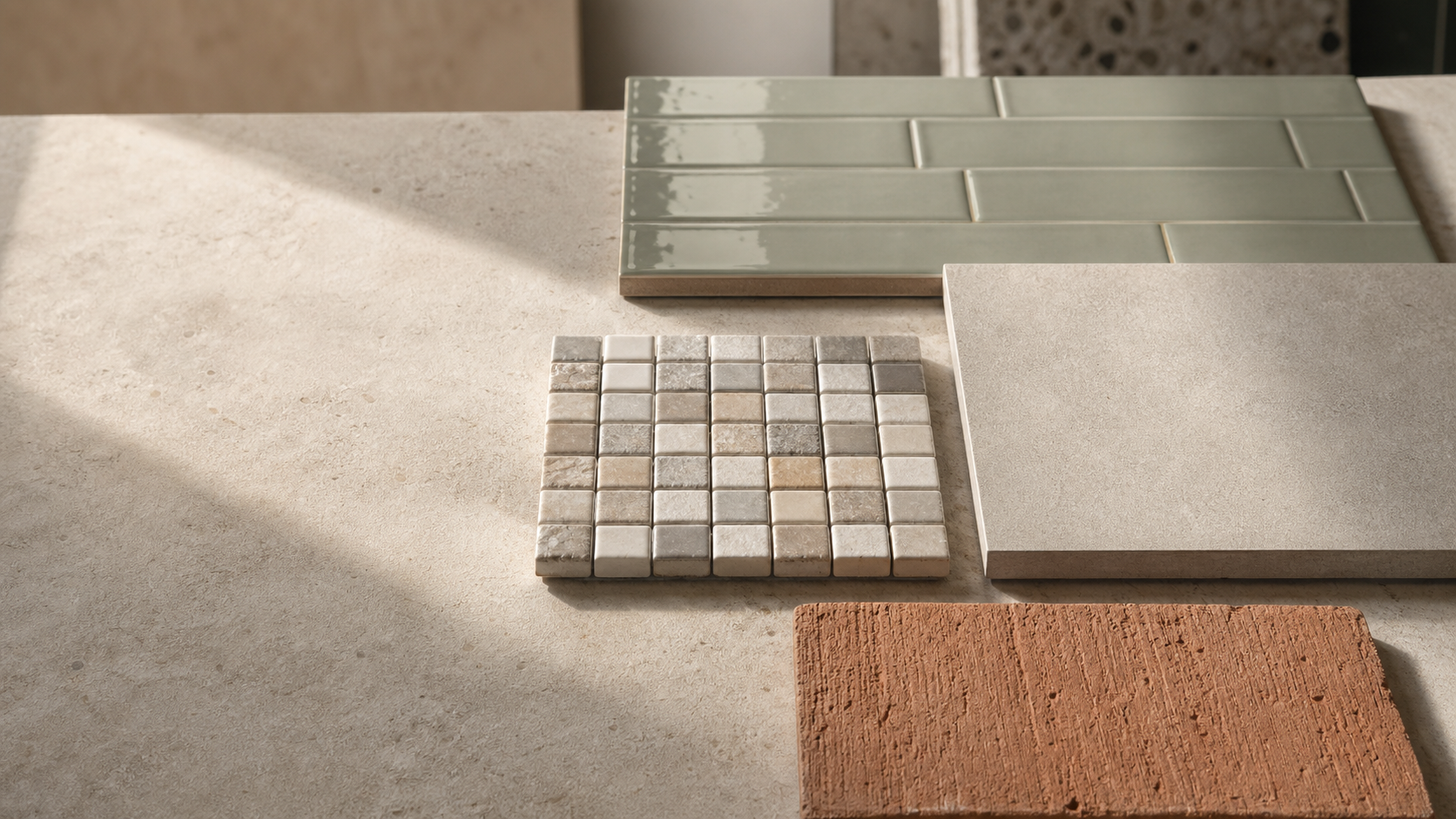
1. Ceramic tile: a versatile choice for walls and light loads
Conventional ceramic tile is made from a clay-based body and fired. It can be glazed or unglazed. A glaze provides a decorative, protective surface, which is why glazed ceramic is common on bathroom walls, kitchen backsplashes, and other interior areas without heavy abrasion.
Ceramic is often lighter and easier to cut than dense porcelain. Do not automatically install a wall tile on a floor: check that the collection is approved for flooring and that its wear and slip characteristics suit the room.
- A strong option for walls, backsplashes, and decorative areas.
- Often easier to cut and handle.
- Use the collection’s intended application, not thickness alone.
2. Porcelain tile: dense material for demanding conditions
Porcelain tile is a ceramic tile with very low water absorption: the international definition uses a limit of 0.5% or less. Its dense body makes it suitable for floors, busy spaces, wet rooms, and many exterior applications when the particular collection is frost-resistant.
Low absorption does not make every porcelain tile suitable for every location. Check slip performance for floors and frost resistance and fixing requirements for terraces or façades. Its density also means the adhesive and cutting tools must be suitable for porcelain.
- Common on floors, shower areas, hallways, and commercial spaces.
- For outdoor use, verify the collection’s technical ratings.
- Large porcelain formats demand a flat substrate and compatible mortar.
3. Mosaic: a small module for curves, niches, and accents
Mosaic consists of small pieces, often mounted on a mesh sheet. It follows small curves, niches, and slopes well, and the extra grout joints can help on a shower floor. Mosaic may be ceramic, glass, stone, or porcelain, so the word “mosaic” alone does not determine the adhesive.
The main challenge is keeping the face flat and the sheet joints invisible. Before installation, check whether mesh can show through translucent glass, whether the adhesive colour is suitable, and how the sheet edge will be finished.
- Useful for niches, borders, curves, and small areas.
- Check slip performance in shower floors.
- Dry-fit sheets so the joins do not form a visible grid.
4. Clinker and terracotta: texture with specific requirements
Clinker is a dense fired material often used for façades, steps, and floors. Terracotta has a warm natural colour and usually a more porous body. For both, check absorption, calibre, adhesive recommendations, and whether the surface needs sealing.
Porous or heavily textured products need different maintenance from smooth glazed tile. Choose grout and sealer before installation: pigment can lodge in texture, and a different joint width changes the visual rhythm of the whole surface.
- Suitable for façades, steps, expressive floors, and rustic interiors.
- Verify frost resistance for exterior work.
- Check grout and sealer compatibility with the surface.
5. A quick way to narrow the choice in store
Start by describing the location: wall or floor, dry or wet, interior or exterior. Then ask for actual size, thickness, shade, calibre, surface rating, slip performance, and adhesive recommendations. For directional patterns, request several pieces from one batch.
Next, test the format in a real layout. Large tile reduces grout lines but raises substrate-flatness and handling requirements. Small tile wraps difficult geometry more easily but increases grout and sheet-alignment work.
- Location and load matter more than a fashionable name.
- The technical sheet matters more than a catalogue photograph.
- View samples in the room’s real light.
- Plan pattern direction as well as box quantity.
Conclusion: choose the material for the use case
Good interior wall ceramic is enough for many vertical surfaces. Floors, moisture, and heavy traffic often point toward porcelain with the right ratings. Mosaic solves small geometry and adds scale; clinker and terracotta add texture but need more attention to maintenance.
Record the technical parameters before buying and check them against the substrate, adhesive, and layout. The tile then becomes part of a working system rather than an isolated purchase.